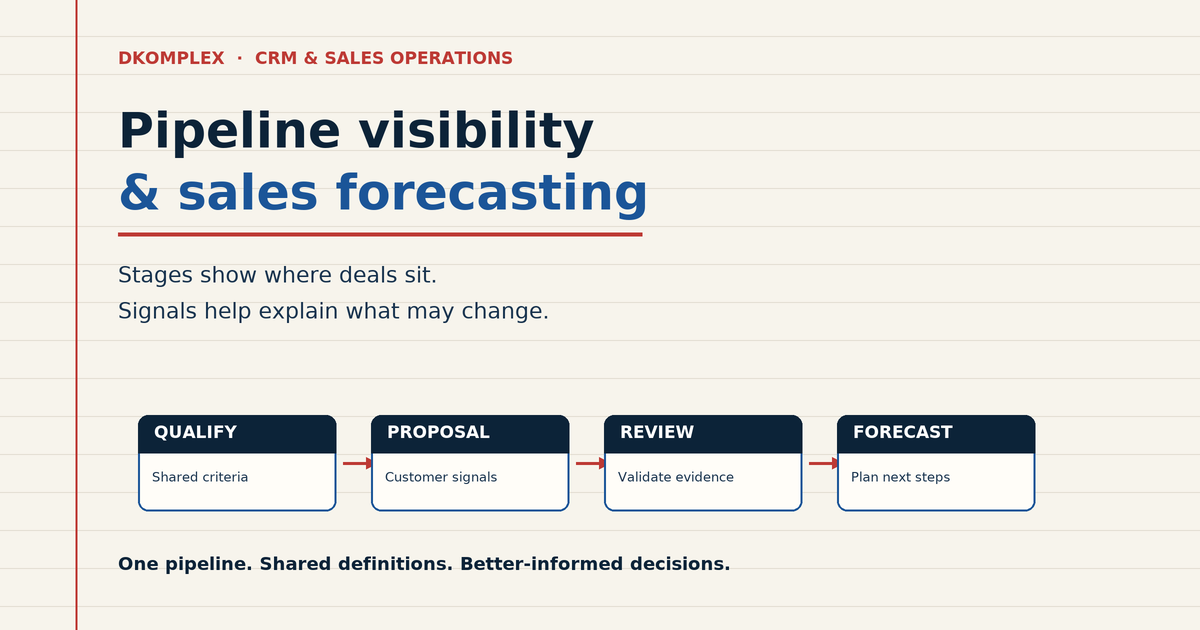
The value of a CRM isn't knowing how many opportunities you have. It's knowing which ones you can count on.
A CEO asks a simple question: "How much business are we going to close next quarter?" The sales manager opens a spreadsheet, the sales team offers its best estimates, and Finance has a different number. Meanwhile, the CRM contains dozens of opportunities that haven’t been updated in weeks. Everyone has an answer, but nobody is entirely confident in it.
This is a common challenge for growing businesses, and it’s one that CRM implementation services can help solve. But the answer isn’t simply installing new software or creating more dashboards. Better sales forecasting begins when everyone shares an understanding of what the pipeline represents, which signals matter, and what those signals tell us about the business.
What Is Sales Pipeline Visibility?
Sales pipeline visibility is the ability to understand where potential business stands throughout the sales process. It means knowing which opportunities exist, how they’re progressing, who is responsible for them, and what needs to happen next.
A useful pipeline helps answer how much potential revenue exists, which deals are moving or stalled, what customer behaviors indicate buying interest, where opportunities get stuck, what may close this quarter, and what needs attention before an opportunity is lost.
Without reliable visibility, sales management becomes reactive. A well-implemented CRM turns scattered information into a shared picture of the sales process. However, visibility is only the beginning. The greater opportunity is learning to recognize what the information is telling us.
1. CRM Implementation Creates a Shared Definition of the Sales Process
Ask five salespeople what it means for an opportunity to be “qualified,” and you might get five different answers. One considers an opportunity qualified when a customer expresses interest. Another waits until a budget is confirmed. A third requires a formal request for quotation.
When every salesperson uses a different definition, pipeline reports become unreliable. A $100,000 opportunity in one salesperson’s pipeline may represent something entirely different from a $100,000 opportunity in another’s.
Professional CRM implementation brings sales leaders, employees, and other stakeholders together to define how the business actually sells. What makes an opportunity qualified? What evidence is required to move it to the proposal stage? When should an opportunity be considered won or lost?
What appears simple often becomes complicated when people come together. Sales may define progress through customer engagement, Finance through contractual commitments, and Operations through the ability to deliver. Each perspective reveals something the others might have missed. The complexity was always there. The conversation simply made it visible.
At DKomplex, we help organizations develop coherence: a shared understanding of how the business operates before asking technology to represent it. That understanding creates consistency, and consistency makes sales information more meaningful.
2. CRM Implementation Improves the Quality of Sales Data
A forecast is only as reliable as the information behind it. Consider an opportunity with an expected close date of October 15 that still appears open in November, or a $250,000 deal without customer interaction in three months. Should those opportunities be included in next month’s forecast?
CRM implementation services establish clear data requirements and processes for maintaining records, including opportunity ownership, expected close dates, next steps, duplicate records, and current values. Automation can reduce manual work through reminders, workflows, and integrations. The goal is not to make employees enter more information, but to make the information useful enough that they want to keep it accurate.
3. The Most Valuable Sales Information May Be Hidden in Signals
Most CRM dashboards tell us what has happened: an opportunity was created, a proposal submitted, a meeting held, or a deal moved to another stage. Some of the most valuable information about future sales, however, may exist in activities that are not currently measured. These are signals: observable events or behaviors that may indicate something is changing.
Consider a significant proposal that remains in the proposal stage. Behind the scenes, the customer has begun redlining the contract. Legal is reviewing terms, Procurement is asking questions, and additional stakeholders are involved. These may be meaningful signals of progress even though the CRM stage has not changed.
Another opportunity in the same stage might have no responses or evidence of continued evaluation. Both look identical on a traditional pipeline dashboard, but tell very different stories. A sales stage tells us where an opportunity has been placed. A signal helps us understand what may actually be happening.
Recognizing signals requires collaboration. Sales may notice engagement, Legal may recognize contract negotiations, and Operations may see delivery or technical validation requests. Together, these observations create a more complete picture of customer intent.
Signals do not always have a single meaning. Redlining could indicate buying interest or unresolved legal concerns. More meetings could mean momentum or uncertainty. Organizations must distinguish observation from interpretation and seek additional evidence. Over time, patterns can reveal which signals precede opportunities advancing, stalling, or closing.
4. Turning Sales Signals Into Better Forecasts
Weighted forecasting adjusts opportunity values by estimated closing probability. A $200,000 opportunity with a 40% probability contributes $80,000 to a probability-weighted forecast. That is not a promise of $80,000 in revenue.
But where did 40% come from? A sales stage, a salesperson’s judgment, or historical performance and customer behavior? If every proposal is assigned a 75% probability while historical wins are only 30%, the forecast will be optimistic.
A good implementation defines probabilities through conversion rates, stage criteria, customer commitments, and meaningful signals. When a customer requests contractual changes, the team can observe, interpret, validate procurement and budget approvals, take an appropriate action, and compare the result with actual outcomes.
The objective is not an elaborate scoring system for every interaction. It is recognizing which activities matter. Microsoft Dynamics 365 and HubSpot both offer configurable forecasting, but the people who know how customers buy must help determine the relevant signals.
5. CRM Dashboards Help Leaders Identify Problems Earlier
A forecast should help leaders understand what to do, not merely whether the business is on track. A dashboard might show enough pipeline to meet a target, but also reveal that 40% of opportunities have remained in one stage for more than 60 days.
Some of those opportunities may have active contract discussions and confirmed follow-ups; others may have no meaningful engagement. A useful dashboard exposes stalled opportunities, conversion trends, delayed close dates, buying signals, and gaps between expected and actual performance.
Managers can prioritize coaching and follow-up. Executives can make better decisions about hiring, purchasing, production capacity, and cash flow. The value is discovering what the data is telling us while there is still time to respond.
6. Connecting CRM With Other Systems Improves Forecasting Context
For many organizations, sales do not end when an opportunity is won. Manufacturers produce goods, service organizations schedule resources, and Finance recognizes revenue according to contractual terms. Disconnected systems can make forecasts misrepresent operational realities.
A manufacturer might have $1 million in expected sales but insufficient production capacity for the projected timeframe. Connecting CRM with ERP, accounting, contract management, and operations can provide context and reveal signals such as vendor documentation requests, production questions, or final contract review.
Connections alone do not create understanding. Potential sales, confirmed orders, scheduled deliveries, and recognized revenue are related but not interchangeable. Shared definitions are necessary or integration can create more confusion.
7. Collaborative Workshops Reveal What Traditional Requirements Gathering Misses
One of the most valuable parts of CRM implementation happens before software configuration, when the right people come together to solve the problem. Leadership may want accurate forecasts; Sales may want less administration; Finance may need consistent definitions; Operations may need better visibility into demand. These are different perspectives on a connected business problem.
At DKomplex, collaborative problem-solving makes these relationships visible. Rather than beginning with a feature list, we bring people together to examine how work happens, challenge assumptions, understand dependencies, and develop solutions they can support.
This can uncover customer signals, constraints, unwritten rules, and informal processes that traditional requirements gathering misses. We are not simply asking what people want software to do. We are helping them discover what the business needs to understand and accomplish.
Our Problem Solving as a Service approach uses structured collaboration to build shared understanding, practical decisions, and collective ownership. Learn more about our collaborative workshops.
8. Employee Adoption Determines Whether Visibility Lasts
Even the best CRM implementation will struggle if the sales team does not use it. People are unlikely to maintain information in a system they do not believe helps them do their jobs.
Sales representatives should shape pipeline stages and identify unnecessary work. Managers should help determine useful signals and reports. Leadership should clarify how pipeline information informs performance decisions. Participation helps employees understand the purpose and contribute improvements.
Our IT+ approach is built around a principle: People support what they help create and know they benefit from. Reliable forecasts depend on a system people understand, trust, and consistently use.
How Do You Know If Your CRM Implementation Is Working?
Success should be measured not only by whether software is live, but by whether the organization makes better decisions. Track forecast accuracy, opportunities with current next steps, conversion rates, delayed close dates, and time spent maintaining pipeline information.
Also test whether identified signals are meaningful. Do contract negotiations consistently precede closed deals? Does broader stakeholder participation correlate with higher conversion rates? What warnings appear before opportunities are lost?
Compare observations with outcomes over multiple periods. If the business forecasts $1 million but closes $600,000, examine opportunity values, close dates, stage definitions, and overlooked signals. Improving the process improves future decisions.
Better Forecasting Starts With Better Understanding
CRM implementation services improve pipeline visibility and forecasting by establishing consistent sales processes, improving data quality, connecting systems, and making useful information accessible. They also offer an opportunity to move from reporting what happened to understanding what might happen next.
That requires recognizing signals, interpreting them in context, and learning which observations matter. Most importantly, it requires people developing a shared understanding of the business. The real transformation is not the dashboard. It is the collective understanding behind it.
Ready to Get More From Your Sales Pipeline?
DKomplex helps organizations improve sales performance through CRM implementation, systems integration, collaborative problem-solving, and people-first technology adoption. As a Microsoft Solutions Partner and HubSpot Solutions Partner, we help businesses implement and improve CRM solutions that support how their teams actually work.
Whether you are starting with spreadsheets, replacing an existing CRM, or improving forecasting in Microsoft Dynamics 365 or HubSpot, we can help identify what needs to change. Explore our collaborative workshops or connect with DKomplex.