New permissions for HubSpot’s ChatGPT connector point toward a future where businesses can manage more of their CRM without waiting for outside technical assistance. But with that freedom comes a greater responsibility to protect existing systems and data.
Your sales manager wants a new way to categorize opportunities in HubSpot.
Traditionally, that request might go to IT, a CRM administrator, or an outside consulting partner. Someone reviews the requirements, configures the system, tests the changes, and deploys them.
Depending on availability, even a relatively small improvement might wait in a queue.
Now imagine describing the desired change to ChatGPT, reviewing its recommendations, and having an authorized employee implement it directly.
That is the opportunity emerging as HubSpot expands what connected AI tools are permitted to access and modify.
But there is an important distinction between making a change easier and making it safe.
What’s Changing With the HubSpot ChatGPT Connector?
HubSpot recently notified connected-app administrators that additional optional permissions are available for its ChatGPT connector.
The notification identifies several configuration capabilities:
- Activating eligible HubSpot-defined CRM object types.
- Customizing eligible HubSpot-defined object types, including renaming them.
- Creating, editing, and deleting association labels between object types.
- Modifying team-based membership settings for segments.
These permissions concern the structure and behavior of a CRM, not simply the information stored inside individual customer records.
For example, association labels can describe relationships between companies, contacts, deals, and other records. Segment settings can influence which records belong to a particular audience.
HubSpot already documents ChatGPT capabilities for creating and updating CRM records, managing activities, and creating certain configuration elements.
However, new optional permissions are not a guarantee that every corresponding action is available through the ChatGPT interface. Availability depends on the connector’s supported tools, the permissions granted, and the user’s HubSpot access.
Notably, HubSpot’s published connector documentation does not currently list editing existing property definitions as a supported action. This should be verified before assuming ChatGPT can directly modify an established field’s configuration.
The Opportunity: More Control for Your Internal Team
For businesses with an internal CRM administrator or IT department, AI-assisted administration could change how improvements are delivered.
Instead of relying on an outside partner for every small request, employees may increasingly be able to investigate a configuration, develop a proposed solution, and implement supported changes themselves.
Consider a sales organization that needs to distinguish different relationships between companies and contacts.
The administrator could ask ChatGPT to help evaluate the requirements, identify the appropriate association structure, and explain how the configuration might affect existing processes.
Where supported, an authorized user could then implement the approved change through the connector.
The benefit isn’t simply speed.
It’s greater organizational independence.
Teams can build their understanding of the system, maintain routine improvements, and reserve outside consulting support for decisions that require deeper expertise.
The Risk: Small Changes Can Have Large Consequences
CRM systems contain years of accumulated information, business rules, and operational dependencies.
A field may appear simple, but it could support reports, automation, integrations, or important customer records.
Consider a property that identifies the type of customer relationship.
If someone changes its options without understanding how existing records use them, reporting categories could become inconsistent. Automated workflows might evaluate records differently. Connected applications may depend on values that are no longer available.
Changing an existing property’s field type presents an even greater concern.
HubSpot explicitly warns that certain field-type changes can invalidate values already stored in CRM records.
Imagine converting a field containing years of customer information into a different format without first examining the data. Depending on the change, existing values may no longer be valid.
An AI assistant might be able to explain or recommend a change without understanding every downstream dependency.
This is why administrative access must not be confused with authorization to make unrestricted changes.
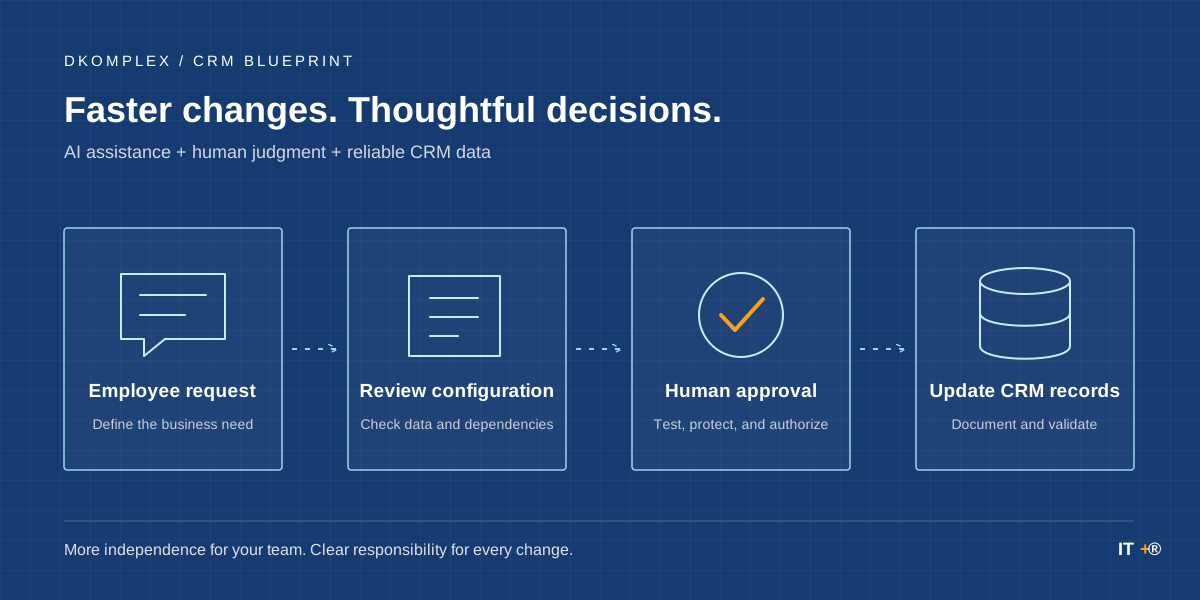
A Safer Process for AI-Assisted CRM Administration
Organizations should treat AI-assisted changes like any other CRM configuration change.
1. Understand the business requirement.
Before modifying anything, establish what problem the change is intended to solve.
Ask whether a new field, association, or automation is genuinely necessary. Sometimes the requested improvement can be achieved using existing functionality.
2. Investigate existing dependencies.
Determine where the affected configuration is used.
Review workflows, forms, reports, segments, integrations, and existing records. Examine whether the proposed change could affect historical information or other departments.
3. Protect the existing data.
For potentially disruptive changes, export relevant data and document the current configuration.
Establish a recovery approach before proceeding. An export alone does not guarantee that every configuration change can be reversed.
4. Test before making changes broadly.
Use a sandbox or another appropriate controlled testing method where available.
Test records with existing values, unusual scenarios, and connected workflows. Confirm that the change behaves as expected.
5. Require human approval and document the result.
HubSpot recommends configuring ChatGPT write actions to require approval. This helps prevent changes from being executed without an explicit review.
Keep a record of what was changed, why it was necessary, who approved it, and what testing was completed.
One additional consideration: HubSpot notes that certain custom validation rules are not applied when records are created or updated through its ChatGPT connector. Organizations should not assume every rule enforced through the normal interface will behave identically through the integration.
The Changing Role of Your CRM Consulting Partner
At DKomplex, we see an opportunity for the relationship between businesses and their technology partners to evolve.
Organizations should not have to depend on an outside consultant for every minor adjustment.
The ideal outcome is a team that understands its CRM, participates in improving it, and has the confidence to manage appropriate changes independently.
That doesn’t eliminate the value of consulting.
It changes where that value is concentrated.
Instead of simply implementing every requested adjustment, a CRM partner can help evaluate the business problem, examine dependencies, recommend a safe approach, and guide employees through important decisions.
In our implementation experience, we have used stakeholder interviews, documented requirements, user acceptance testing, role-based training, and technical handoffs to help organizations establish more sustainable processes.
These practices become even more important when AI lowers the effort required to make changes.
Our IT+® philosophy is built around a simple principle: people support what they help create and know they benefit from.
AI-assisted administration can support that principle by giving employees a more active role in maintaining the systems they use.
Faster Changes Should Lead to Better Decisions
The expansion of HubSpot’s ChatGPT permissions is another step toward business applications that employees can interact with using natural language.
This could reduce delays, make routine administration more accessible, and help organizations become less dependent on external technical resources.
But speed is not the objective by itself.
The real opportunity is to make CRM improvements faster while preserving the reliability of the processes and information your business depends on.
The organizations that benefit most will be those that combine new AI capabilities with clear ownership, appropriate permissions, reliable testing, and employee understanding.
Make CRM Changes With Confidence
DKomplex helps organizations implement, optimize, and manage HubSpot through collaborative problem-solving, HubSpot consulting and onboarding, CRM consulting, systems integration, data governance, and employee training.
Whether you’re introducing AI-assisted administration or considering an important change to your existing CRM, we can help your team evaluate the impact, develop a safe implementation approach, and build the internal capability to manage more improvements independently.
You don’t always need a consultant to make the change. Sometimes you need a consultant to help ensure you’re making the right change.
Schedule a free CRM Discovery Call with DKomplex to discuss your HubSpot environment and how your team can safely take greater ownership of its CRM.
DKomplex | Complex problems made simple.