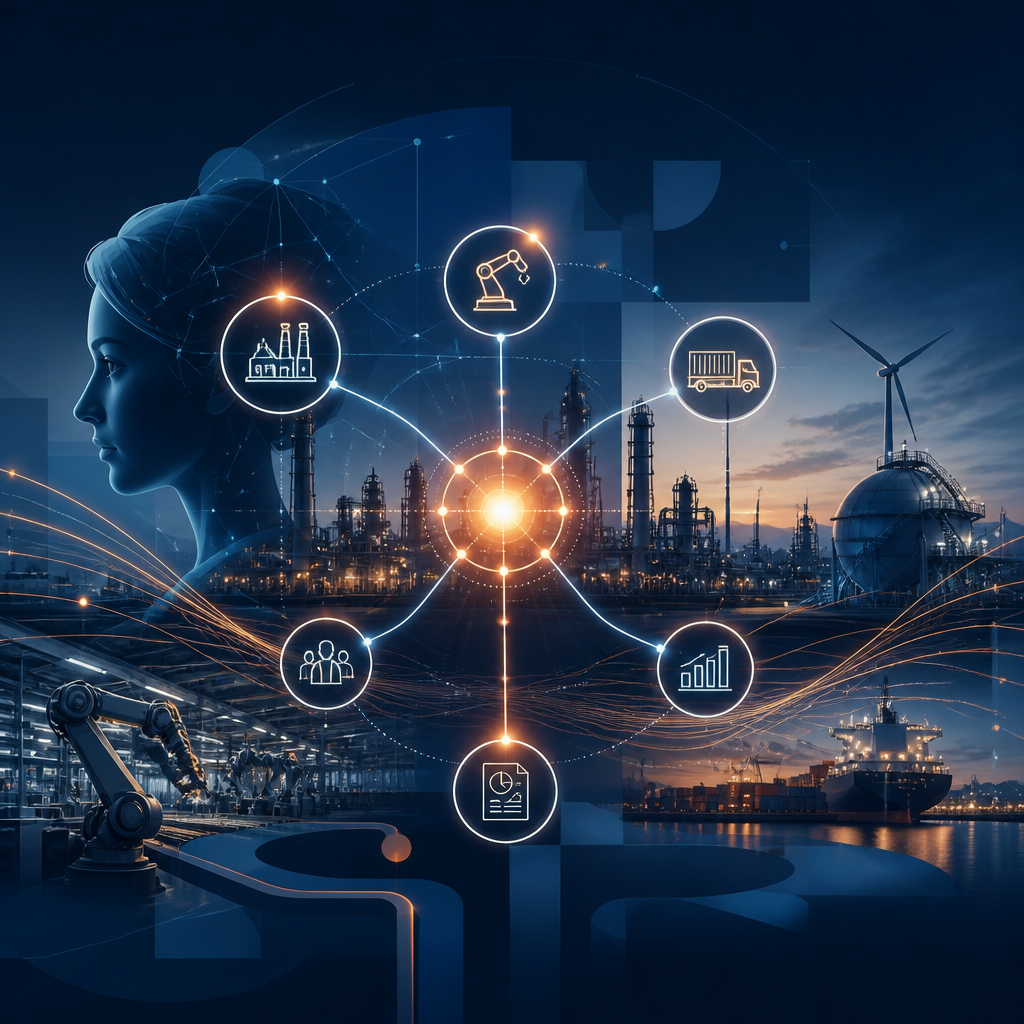
The next competitive advantage in AI may not come from making individual tasks faster. It may come from helping an entire organization make better decisions together.
A manufacturer can have excellent production software and still struggle to deliver orders on time. Sales may know what customers want, operations may know what the factory can produce, and finance may understand the costs. Yet decisions are often made separately, using different systems, information, and assumptions.
Artificial intelligence can make each department faster. But if the departments remain disconnected, the organization may simply become faster at making decisions that don't agree with one another.
A major AI partnership announced on November 2, 2026, illustrates why this distinction matters.
A New Industrial AI Partnership Points Toward Connected Decisions
Abu Dhabi National Oil Company (ADNOC) announced a multiyear partnership with OpenAI and G42 to deploy OpenAI Frontier across complex energy operations. According to ADNOC's announcement, the initial work will connect technical, operational, capital, and commercial information that has traditionally been analyzed in separate processes. Reuters independently reported the agreement.
The partnership identifies two initial applications. One involves integrating decades of reservoir and facility data with economic considerations to support field development planning. The other aims to connect production, refining, logistics, sales, and trading information so decision-makers can evaluate commercial and operational consequences together.
ADNOC says the approach is intended to accelerate planning and improve decisions. Those are objectives of the announced deployment, not independently demonstrated results.
What makes the announcement interesting isn't simply the use of powerful AI models. It's the ambition to connect knowledge and decisions across an entire organization.
That is a challenge businesses of nearly every size recognize.
The Problem With Optimizing One Department at a Time
Consider a hypothetical manufacturing company that introduces AI into its sales process. The system analyzes customer inquiries, identifies promising opportunities, and helps representatives prepare quotations.
Meanwhile, production uses another AI tool to optimize equipment schedules. Procurement uses a third to manage materials, and finance uses a fourth to forecast cash flow.
Each system might perform its assigned task well. But what happens when sales promises a delivery date that production cannot support? Or when procurement identifies a material shortage that hasn't reached the sales forecast?
The organization has improved individual activities without necessarily improving the decisions connecting them.
This is where industrial AI integration becomes important. Rather than treating AI as a collection of isolated applications, businesses can use connected data and workflows to help employees understand the broader consequences of their decisions.
For example, a proposed customer order could be evaluated against available inventory, production capacity, supplier lead times, delivery commitments, and expected profitability.
The goal isn't for AI to make every decision automatically. It's to make relevant information available when people need to decide.
AI Agents Need More Than Access to Data
Modern AI agents can retrieve information, use business applications, and carry out defined activities. But access to information isn't the same as understanding it.
A sales opportunity valued at $500,000 is not necessarily a confirmed order. A scheduled production run does not guarantee available inventory. A customer-requested delivery date is not necessarily a commitment the business has accepted.
These distinctions may be obvious to experienced employees, yet they can be lost when systems exchange information without agreed definitions.
This is why connecting CRM, ERP, inventory, and financial systems requires more than technical integration. Organizations must establish what their information represents, which system is authoritative, how exceptions are handled, and who has responsibility for consequential decisions.
OpenAI's February 2026 introduction of Frontier described shared context, business-system integration, feedback, and permissions as foundations for enterprise AI agents. Its subsequent announcement of implementation alliances also emphasized workflow redesign, leadership alignment, and change management.
The technology can connect information. People must establish what that information means.
Better AI Starts With Organizational Coherence
One of the most overlooked challenges in technology projects is that different people often hold different, incomplete understandings of the same business process.
Ask sales, operations, and finance to define a completed order, and the conversation may reveal several legitimate answers. Sales may consider the order complete when the customer signs. Operations may focus on shipment. Finance may focus on invoicing or payment.
These differences aren't necessarily mistakes. They reflect different responsibilities.
The problem arises when technology is configured as though everyone shares the same definition.
Bringing people together to examine these differences can uncover complexity that initially seemed invisible. It also creates an opportunity to establish coherence: a shared understanding of the problem, the information required, and the outcomes the organization wants to achieve.
At DKomplex, this is central to our people-first IT+® approach. Our collaborative problem-solving workshops bring stakeholders together to explore problems, examine evidence, evaluate alternatives, and agree on practical solutions before committing to technology changes.
A successful AI implementation needs that foundation. Otherwise, automation may reinforce the very misunderstandings the organization hoped to eliminate.
Five Questions to Ask Before Connecting AI Across Your Business
Organizations don't need to begin with a company-wide AI transformation. A smaller, clearly defined business problem is often a better starting point.
First, identify a decision that regularly crosses departments. It might involve delivery commitments, sales forecasting, production scheduling, or customer service escalation. Choose a problem where better coordination could produce a measurable improvement.
Second, determine what information the decision requires. Identify the systems, records, and people involved. Pay attention to missing information, inconsistent definitions, and informal workarounds.
Third, agree on what the information means. Establish shared definitions for critical concepts such as qualified opportunity, available inventory, committed delivery date, or completed service request.
Fourth, decide where human judgment remains essential. AI may gather information, identify conflicts, and recommend actions. Employees should retain appropriate oversight, particularly where financial commitments, customer relationships, safety, or compliance are involved.
Finally, measure whether decisions improve. Track outcomes such as quotation turnaround time, forecast accuracy, on-time delivery, avoidable rework, or time spent resolving exceptions. Compare results against a baseline rather than assuming that more automation means better performance.
These questions help organizations distinguish between an interesting AI demonstration and a practical business improvement.
The Opportunity for Manufacturers and Growing Businesses
The ADNOC announcement involves an enormous industrial enterprise, but the underlying challenge is not unique to large organizations.
A smaller manufacturer may have customer opportunities in HubSpot or Microsoft Dynamics 365, inventory information in an ERP system, and production schedules in spreadsheets. A service business may have customer requests, technician availability, contracts, and billing information scattered across several applications.
Connecting those systems can make information more accessible. Establishing shared business context can make that information more useful.
And when employees participate in designing how information and decisions flow, the organization gains something technology alone cannot provide: shared ownership.
At DKomplex, we believe people support what they help create and know they benefit from. That principle is particularly important as businesses introduce AI into work that spans multiple teams.
The Future of Industrial AI Is a Connected Business
The most significant promise of industrial AI isn't simply reducing the time required to complete individual tasks. It's helping organizations understand how those tasks, decisions, and responsibilities affect one another.
That requires reliable data, thoughtful systems integration, clearly defined processes, and people who understand and trust the solutions they use.
A business doesn't necessarily need another AI tool. It may need a better understanding of how its existing tools, information, and people should work together.
The competitive advantage isn't just faster decisions. It's better decisions made with a more complete understanding of the business.
Ready to Connect Your Business Systems and Decisions?
DKomplex helps organizations solve complex business problems through CRM consulting, Microsoft Dynamics 365, HubSpot, Power Platform, systems integration, and collaborative problem-solving.
Our IT+® approach begins with people and the problems they're trying to solve, then brings technology into the process where it can create meaningful value.
Explore our Problem Solving as a Service workshops or connect with DKomplex to discuss how better integration and shared understanding could improve your business operations.
DKomplex | Complex problems made simple.
Sources
- November 2, 2026: ADNOC's official partnership announcement, the primary source for the proposed industrial AI applications, integration goals, and human oversight.
- November 2, 2026: Reuters' independent report on the ADNOC, G42, and OpenAI agreement.
- February 23, 2026: OpenAI's Frontier Alliances announcement, background on enterprise AI implementation, integration, and organizational change.